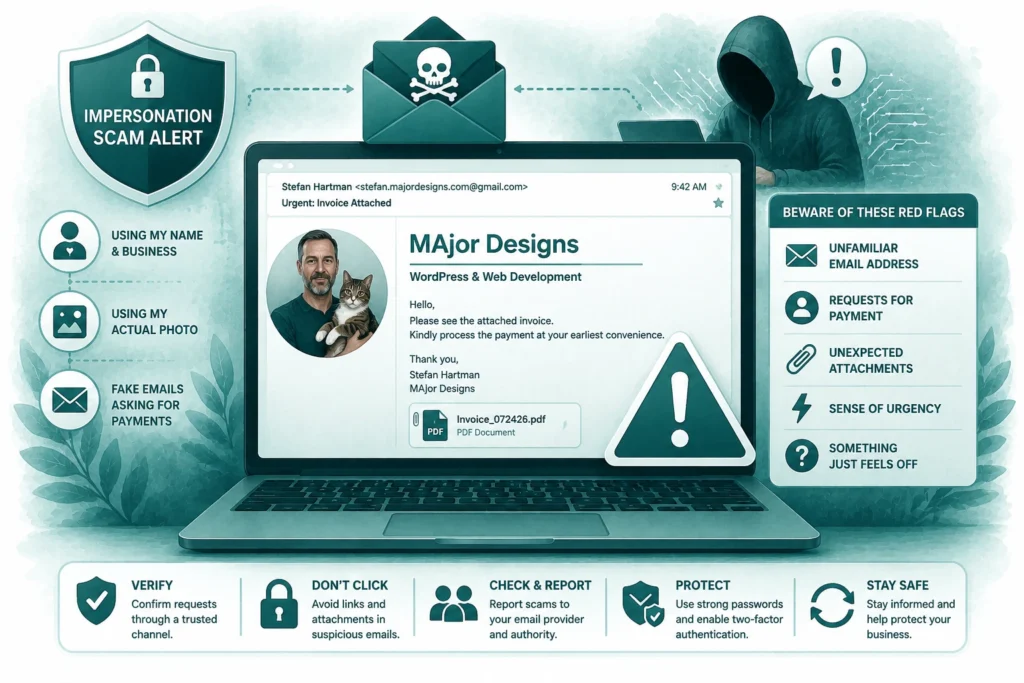
A few months ago, I published a warning titled “How One of My Clients Lost $200 to an Email Imposter Scam.” That article explained how scammers were creating Gmail accounts that looked similar to MAjor Designs, contacting my actual clients, and pretending to be me.
Unfortunately, they are back. This time, the emails came from two more fake Gmail addresses:
- stefanmajordesign@gmail.com
- stefan.majordesigns.com@gmail.com
No one lost money during this round, thankfully. Several clients noticed something was wrong and contacted me before responding or taking action. That is exactly what I have been asking clients to do, and it prevented this situation from becoming much worse.
However, I still had to contact my clients again, explain that the messages were fraudulent, reassure them that their websites were not about to be shut down, and ask them to report or delete the emails.
What makes this latest round especially troubling is how much more effort the impersonators put into making the emails look legitimate.
The Fake WordPress Compliance Deadline
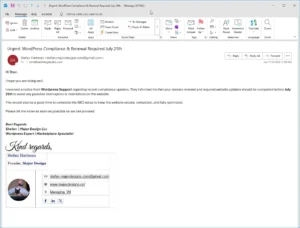
The emails used subject lines such as “Urgent: WordPress Compliance & Renewal Required July 9th” and “Urgent: WordPress Compliance & Renewal Required July 25th.”
One message claimed that I had received a call from “WordPress Support” following a conference meeting. It then warned the recipient that their website had not complied with required updates and that a domain renewal and plugin setup had to be completed before an approaching deadline.
The recipient was told that failing to act could cause the website to be flagged, restricted, interrupted, or completely shut down by WordPress. None of that was true. I did not receive a call from WordPress Support. There was no compliance notice. There was no universal July deadline, and the clients receiving these messages were not in danger of having their websites shut down.
The scammers then added another familiar service to the message by suggesting that it was also the “right time” to complete a full SEO setup. That was likely intended to begin a conversation, establish trust, and eventually lead to a fraudulent invoice or payment request.
This is a common scam tactic: create an urgent problem, imply that the recipient’s business is in danger, and pressure them to respond before they have time to verify the story.
They Copied My Branding and Built Fake Signatures
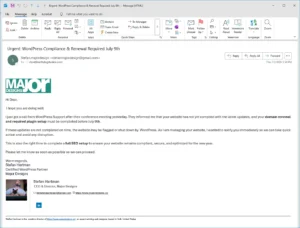
The first message included a copy of the MAjor Designs logo, my correct name, a link to my website, and a professionally formatted email signature. It falsely described me as a “Certified WordPress Partner” and the “CEO & Director” of “Major Designs.” The second message used a different signature design containing contact information, location details, and Facebook, LinkedIn, and X icons. Those social media icons did not lead to my actual social media accounts. The signatures were designed to give recipients a sense of legitimacy. Scammers know that people often glance at a logo, photo, website address, or familiar name and assume the rest of the message must be real.
But several details were wrong.
My company name is MAjor Designs. That unusual capitalization is intentional and has been part of my branding for years. The fake messages referred to the business as “Major Designs,” “Major Design,” and “Major Design LLC.”
MAjor Designs is not “Major Design LLC.”
One signature also listed a location in Menasha, Wisconsin. I am based in York, Pennsylvania. Another signature misspelled my first name as “Shefan.” It also used “Wordpress” rather than the properly styled “WordPress.” Those errors may look obvious after the fact, but they can be easy to overlook when an email contains the correct website, recognizable branding, a familiar photograph, and a warning that something bad is about to happen.
The Part That Crossed a Personal Line
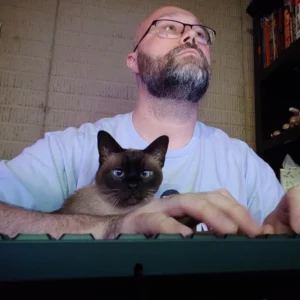
The most upsetting part of this round was not the incorrect business name, the fake title, or even the attempt to frighten my clients. It was the photograph they used. The scammers copied a photo from my LinkedIn profile showing me holding our cat, Frank. Frank passed away only a few months ago. That photograph was not simply a business headshot or a generic image taken from a company website. It was a personal photo of me with a member of our family whom we recently lost. Seeing it taken, copied into a fraudulent email signature, and used to manipulate my clients was infuriating.
Frank was not a marketing asset for scammers to use. He was family.
In my previous warning, I specifically told clients that I would never place a photograph of myself in my normal email signature. This time, the impersonators appear to have gone searching for a photo that would make the messages feel more personal and believable.
That demonstrates how these scams are evolving. The people behind them are not merely choosing a similar email address and sending a poorly written message. They are gathering public information, copying images, reproducing logos, building elaborate signatures, and creating multiple versions of the same story.
The Gmail Address Is Still the Biggest Warning
Despite all the extra decoration, the biggest warning sign remains the sender’s actual email address.
MAjor Designs does not conduct business through a Gmail address.
My legitimate business email is:
stefan@majordesigns.co
An address ending in @gmail.com is not transformed into an official MAjor Designs address simply because the scammers place “stefan,” “major,” “designs,” or even “majordesigns.com” before the @ symbol.
For example:
stefan.majordesigns.com@gmail.com
The domain controlling that address is still gmail.com. Everything before the @ symbol is only the Gmail username. This is especially easy to miss on a phone, where email applications may initially display only a sender name such as “Stefan Hartman.” Always tap or click the sender information and inspect the complete email address before responding.
They Keep Creating New Variations
The fake addresses connected to these incidents have now included several variations:
- stefan.majordesigns@gmail.com
- hello.majordesigns@gmail.com
- stefanmajordesign@gmail.com
- stefan.majordesigns.com@gmail.com
Reporting one account does not prevent the person responsible from creating another slight variation. That is why awareness is more reliable than memorizing a single fraudulent address.
The important rule is simple: any Gmail account claiming to represent MAjor Designs or Stefan Hartman is fraudulent.
No Money Was Lost This Time
There is one positive outcome from this latest incident. My clients stopped and checked. They did not assume that a logo, photograph, familiar name, or urgent subject line made the message legitimate. They forwarded the emails to my real address and asked whether I had sent them. That brief verification prevented anyone from losing money.
I realize that receiving another warning from me is inconvenient and frustrating. It is also frustrating for me to repeatedly contact clients about messages I did not send. But I would much rather answer ten verification emails than learn that another client trusted one of these impersonators and sent them money.
What to Do If You Receive One of These Emails
If you receive an unexpected email claiming to be from me, especially one involving a deadline, website shutdown, domain renewal, SEO service, plugin installation, invoice, or payment request, do not reply directly to it.
Instead, start a completely new message addressed to stefan@majordesigns.co, or contact me using information you already have saved.
Do not use the phone numbers, email addresses, social media icons, or contact links contained inside the suspicious message. Those details may have been inserted or altered by the scammer.
I have reported these latest Gmail accounts to Google and preserved copies of the messages. I will continue warning clients and documenting new variations as they appear.
Final Thoughts
The first time this happened, one of my clients lost approximately $200. This time, no one did. That difference came down to awareness and verification. The emails are becoming more detailed. The signatures look more professional. The scammers are stealing branding, using personal photographs, adding fake social media links, and creating false deadlines designed to frighten people into responding quickly.
But all of those details fall apart when someone pauses long enough to inspect the real sender address and independently confirm the request. Please remember:
MAjor Designs will never contact you from a Gmail address. My legitimate business communication comes from the majordesigns.co domain.
When something feels unusual, rushed, or out of character, stop and ask. That single step is what protected my clients during this latest round.