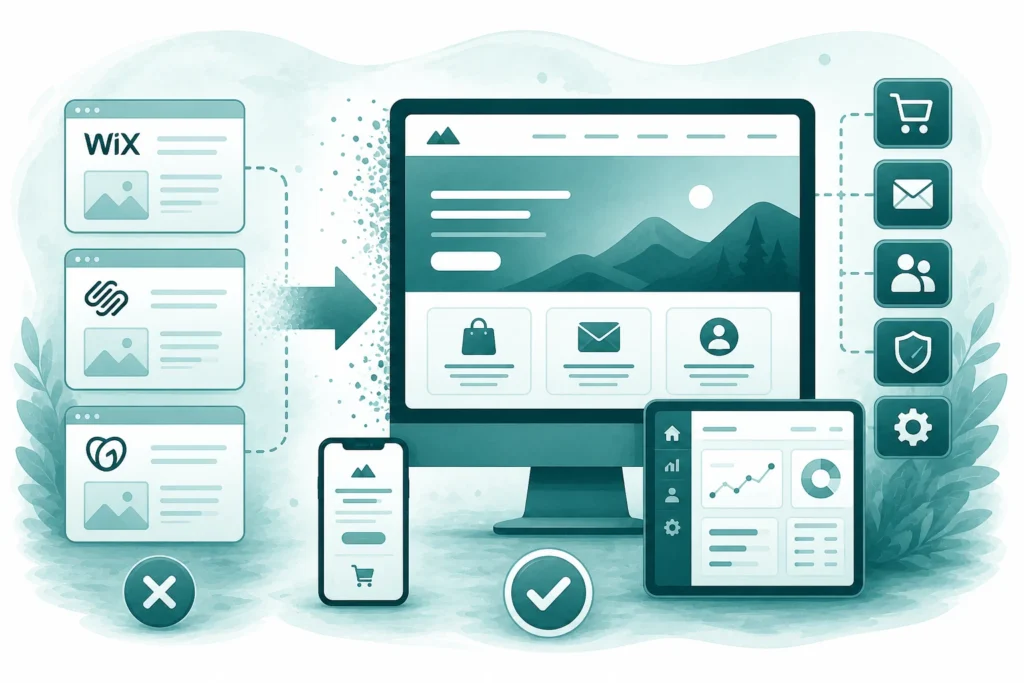
For many businesses, platforms like Wix, Squarespace, and GoDaddy Website Builder are the reason they were able to launch a website in the first place.
And honestly, that’s a good thing.
Years ago, getting a website online often meant hiring a developer, learning hosting terminology, configuring servers, and spending thousands of dollars before a single page even went live. DIY website builders changed that. They allowed small businesses, startups, nonprofits, and side projects to establish an online presence quickly and affordably.
For many businesses, those platforms are the perfect starting point. But eventually, growth changes things. The website that once felt “good enough” slowly starts becoming restrictive. Businesses evolve, customer expectations increase, workflows become more complex, and suddenly the simple drag-and-drop platform that got the company online starts creating limitations instead of solving problems.
That’s usually the point where businesses begin looking for another developer.
The Problem Usually Isn’t the Platform
One of the biggest misconceptions in web development is that platforms like Wix or Squarespace are “bad.” They’re not. The real issue is that most businesses eventually need their website to do more than it originally did. At launch, a business might only need a homepage, a contact form, a gallery and a few informational pages. But after a few years, things change. Now the business wants:
- Better SEO performance
- Custom lead generation
- Advanced eCommerce functionality
- Third-party integrations
- Appointment systems
- Employee portals
- Gated member content
- API integrations
- Custom workflows
- Improved performance and security
That’s where many businesses begin running into friction with DIY platforms.
Even technology reviewers acknowledge that many website builders can become limiting as project complexity grows. TechRadar noted that some platforms work well for “basic websites” but users may “hit limitations fast if needs grow beyond basic websites”.
That’s an important distinction. The problem often isn’t the platform itself. The problem is growth.
Businesses Often Outgrow Convenience
DIY platforms are designed around simplicity and accessibility. That convenience is their biggest strength. But convenience can also become restrictive. As businesses scale, owners often discover that they have limited control over:
- Functionality
- Integrations
- Performance
- Design flexibility
- Server-level optimizations
- SEO structure
- Long-term scalability
And sometimes the limitations are operational, not technical. One of the most common problems businesses run into is ownership and account management. Over the years, it’s surprisingly common for businesses to discover:
- Login credentials were lost
- Former employees controlled accounts
- Agencies disappeared
- Billing ownership is unclear
- Nobody actually knows how the website was originally set up
At that point, even simple updates can become difficult.
A Real-World Example: Hunter’s Hill Eyecare
A recent project for Hunter’s Hill Eyecare is a perfect example of how these situations happen.
The business originally operated on a Wix-based website managed internally by a former employee. Over time, access to the platform became a problem because account credentials were no longer available or shared properly.
That situation left the business in a difficult position:
- Limited administrative control
- Limited ability to update or expand the website
- Uncertainty surrounding long-term management of the platform
Rather than continuing to work around those limitations, the decision was made to rebuild the website entirely. The result wasn’t simply a “replacement” website. It became an opportunity to:
- Modernize the design
- Improve performance
- Improve SEO structure
- Increase flexibility
- Simplify long-term management
- Create a platform that could evolve alongside the business moving forward
Situations like this are far more common than many business owners realize. A website may initially feel like a quick and affordable solution, but over time the lack of ownership, scalability, or flexibility can create operational headaches that ultimately require a full rebuild anyway.
Growth Changes What Businesses Need From a Website
Modern websites are no longer just digital brochures. Today’s business websites often function as:
- Marketing systems
- Lead generation tools
- Employee resources
- Customer portals
- eCommerce platforms
- Membership systems
- Scheduling systems
- Operational hubs connected to third-party services
That complexity changes the type of infrastructure businesses need. Research surrounding low-code and no-code platforms has also highlighted that while these systems dramatically improve accessibility and speed, they can introduce tradeoffs related to scalability, flexibility, and long-term customization depending on project requirements. Low-Code and No-Code Development Platforms Research Paper
That doesn’t mean businesses should avoid DIY builders. It simply means there comes a point where businesses may need solutions designed specifically around their operations instead of trying to force operations into the limitations of a platform.
The Cheapest Website Is Rarely the Cheapest Long-Term
One of the biggest surprises business owners encounter is how quickly “cheap” website solutions can become expensive over time. As needs grow, businesses often begin adding:
- Premium subscriptions
- Third-party apps
- External marketing tools
- Upgraded plans
- Custom plugins
- Workaround services
What initially felt inexpensive slowly accumulates recurring costs and technical complexity. At the same time, performance, flexibility, and ownership may still remain limited. That’s often the tipping point where businesses begin evaluating custom-built solutions that provide:
- Greater control
- Stronger performance
- Cleaner integrations
- Better scalability
- Clearer long-term ownership
Websites Should Grow With the Business
A good website platform should support growth, not restrict it. For some businesses, Wix, Squarespace, or GoDaddy may continue working perfectly for years. There’s absolutely nothing wrong with that.
But for businesses that are growing, evolving, integrating systems, or depending heavily on their online presence, there often comes a point where custom development becomes the smarter long-term investment.
Not because the original platform failed. But because the business outgrew it. That’s a very different conversation.
Looking Beyond DIY Website Builders?
MAjor Designs works with businesses that need more flexibility, better long-term scalability, and custom solutions tailored to real-world operational needs. From custom WordPress development and WooCommerce systems to API integrations, membership platforms, employee portals, and performance optimization, MAjor Designs helps businesses transition beyond the limitations of one-size-fits-all website builders.