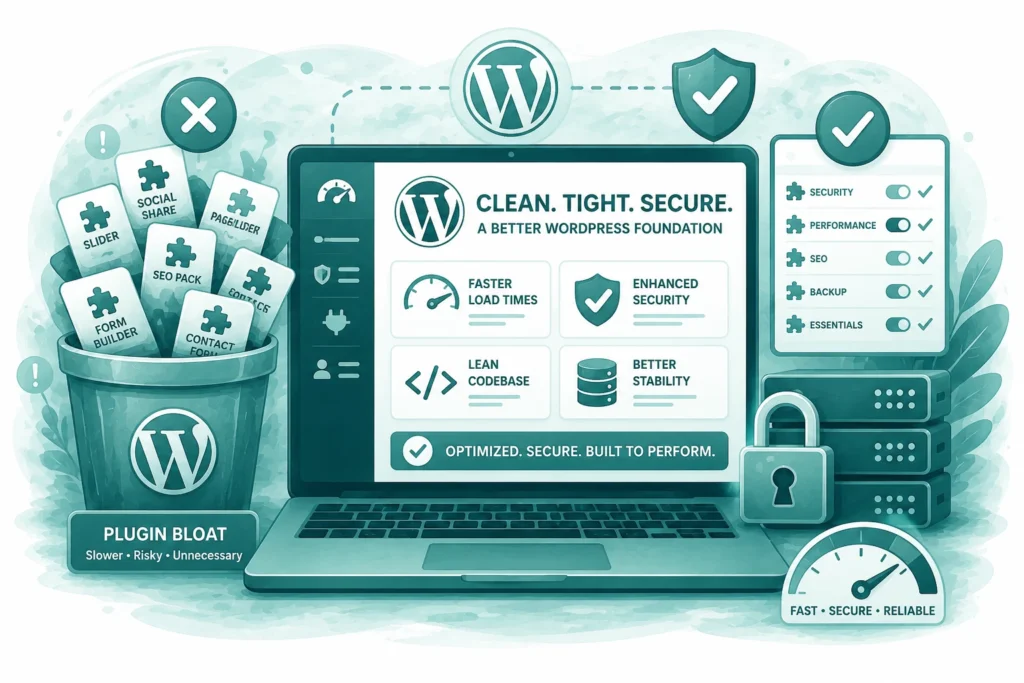
One of the biggest misconceptions about WordPress is that every problem should be solved with another plugin.
Need a slider? Install a plugin.
Need forms? Install a plugin!!
Want popups, SEO tools, backups, galleries, social feeds, custom layouts, tracking scripts, performance optimization? INSTALL MORE PLUGINS!!!
Then the plugins need updates…the theme updates…one plugin conflicts with another plugin…the contact form stops sending emails….the checkout page breaks…
Now the website’s slow.
Now Google hates it.
Now every update feels like rolling dice.
And the whole time, the business just wants the website to work. Over time, many WordPress websites slowly turn into a tangled mess of overlapping functionality, bloated code, and constant updates. Eventually, the site becomes harder to maintain, slower to load, and far more fragile than it should be.
That’s where custom WordPress development becomes incredibly valuable.
At MAjor Designs, I build custom WordPress themes and functionality specifically around what a business actually needs — not around whatever plugins happen to exist.
What “Plugin Bloat” Actually Looks Like
Most plugin bloat doesn’t happen all at once. It builds gradually over the years. A business launches their website with a theme and a handful of plugins. Then new requests come in. Maybe marketing wants a popup. Maybe someone wants testimonials displayed differently. Maybe the business adds WooCommerce, event management, memberships, or custom forms. Before long, the website has:
- 35 active plugins
- Multiple page builders
- CSS loading from six different places
- JavaScript conflicts appearing randomly
- Features nobody even uses anymore
And the worst part? Many of those plugins are loading code across the entire website — even on pages where they aren’t being used. That creates:
- Slower page speeds
- Larger page sizes
- Increased security exposure
- Higher chances of plugin conflicts
- More difficult troubleshooting
For businesses relying on their website every day, those problems eventually become very real.
Why I Prefer Custom WordPress Theme Development
When I build custom WordPress themes, the goal is simple:
Only load what the website actually needs.
Instead of installing massive “do everything” plugins, I typically build lightweight functionality directly into the theme or through focused custom development. That means:
It also allows the website design and functionality to work together naturally instead of fighting against the limitations of a prebuilt system.
A lot of modern WordPress websites are carrying around enormous amounts of unused code just because a plugin developer needed to support thousands of possible use cases. Custom development removes that overhead.
Real-World Examples of Plugin Bloat Problems
Page Builders Doing Too Much
One of the most common issues I encounter is websites that rely heavily on oversized page builders. Tools like Divi and Elementor can absolutely serve a purpose, especially for quick launches or simple editing needs. But over time, businesses often discover they’re loading massive amounts of CSS, JavaScript, animations, and layout systems on every page — whether they need them or not.
That overhead adds up fast.
For many clients, I move them toward custom themes built specifically for their content structure and goals. The result is usually:
And most importantly, the website becomes tailored to the business instead of forcing the business to work around the theme.
Replacing Multiple Plugins with One Focused Solution
Sometimes a website accumulates plugins simply because no single plugin does exactly what’s needed. I’ve worked on projects where businesses were using:
- One plugin for popups
- Another for custom fields
- Another for layouts
- Another for conditional content
- Another for shortcodes
In many cases, those systems can be consolidated into lightweight custom functionality designed specifically for that website. Instead of stacking generic tools together, the website becomes a focused system that’s easier to manage and significantly more efficient.
WooCommerce Stores Are Especially Vulnerable
WooCommerce stores tend to experience plugin bloat faster than almost any other type of website. That’s because store owners are constantly trying to improve:
Before long, stores end up relying on dozens of add-ons layered on top of each other. I’ve helped businesses replace multiple WooCommerce extensions with custom-built solutions tailored specifically to their workflow. In many cases, this not only improved performance but also reduced monthly plugin licensing costs.
Plugin Bloat Isn’t Just About Speed
Performance is only part of the problem.
Every additional plugin introduces:
- More update requirements
- More potential vulnerabilities
- More compatibility risks
- More third-party code you don’t control
And when something breaks, troubleshooting becomes far more difficult because there are so many moving parts involved.
One plugin update can suddenly create:
- Layout problems
- Fatal PHP errors
- Broken checkout pages
- Mobile display issues
- Conflicts with caching or optimization tools
This is one of the biggest reasons I focus heavily on streamlined development and reducing unnecessary dependencies whenever possible.
A Website Should Be Built Around the Business
One thing I’ve learned over the years is that businesses rarely fit neatly into prebuilt systems. Every company has different:
Custom WordPress development allows the website to adapt to the business instead of forcing the business to adapt to the website. That flexibility becomes incredibly important as a company grows.
The Long-Term Benefits of Custom Development
Custom WordPress development isn’t about making things complicated.
It’s actually the opposite.
The goal is to create:
- Simpler systems
- Better performance
- Cleaner maintenance
- More stability
- More control over the future of the website
A well-built custom theme can often outperform large commercial themes while being easier to manage long term.
And when updates or new features are needed later, the foundation is already designed specifically for the business.
Final Thoughts
Plugins absolutely have their place. I use them regularly when they make sense. But when a website starts depending on dozens of plugins just to function properly, problems usually follow. That’s why I focus on building custom WordPress solutions that are lean, scalable, and built around how a business actually operates. Sometimes the best optimization isn’t another plugin…
…it’s needing fewer plugins in the first place.
Need a Faster, Cleaner WordPress Website?
If your WordPress website feels bloated, slow, difficult to manage, or overloaded with plugins, I can help simplify things with custom development built specifically for your business.