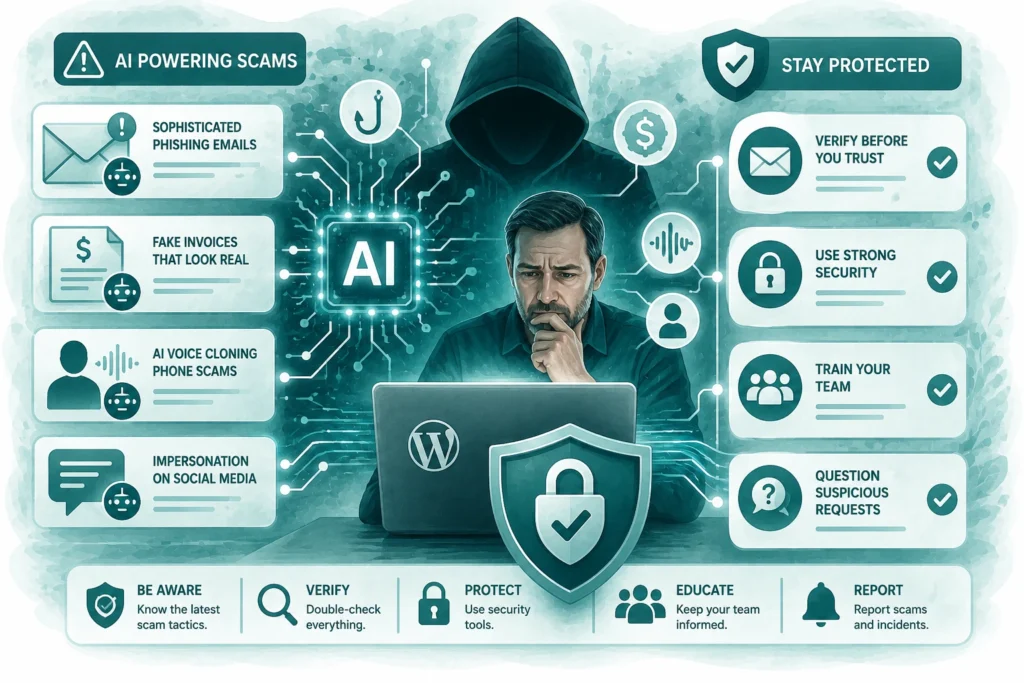
Artificial intelligence is making a lot of legitimate business work faster. It can help write emails, summarize meetings, generate ideas, answer customer questions, and automate repetitive tasks.
Unfortunately, scammers figured that out too.
The same tools that help a small business owner write a cleaner proposal can also help a scammer write a cleaner phishing email. The same AI voice tools that can create realistic audio can also be used to imitate a business owner, employee, vendor, or client. The same technology that can build a quick landing page can also build a fake version of a real company’s website.
That does not mean every business owner should panic. It does mean the old scam warning signs are not enough anymore.
Bad grammar, weird formatting, broken English, and obviously fake email templates used to make scams easier to spot. AI is smoothing out those rough edges. The scam may now look polished. The email may sound normal. The message may reference real people, real companies, real projects, and real invoices.
That is what makes this new wave different.
The danger is not that every scam is brilliant. The danger is that scams are becoming easier to produce, easier to personalize, and harder to dismiss at a glance.
Small Businesses Are Very Much on the Radar
A lot of small business owners assume scammers are only chasing large companies with bigger bank accounts. That is not how this works.
Small businesses often have fewer layers of approval, fewer internal security policies, and more informal communication. The owner might approve payments directly. A bookkeeper may handle invoices by email. A staff member might be trusted to click a vendor link or reset an account password without a second thought.
That makes small businesses attractive targets.
The Federal Trade Commission and NIST have both been focusing directly on scams and cybersecurity risks affecting small businesses in 2026, including phishing, impersonation, fake invoices, business email compromise, and recovery steps after an incident.
The point is not that small businesses are careless. It is that small businesses are busy.
When you are answering emails, helping customers, managing invoices, updating the website, checking payroll, dealing with vendors, and putting out random fires all day, a believable scam can sneak into the normal flow of business.
That is exactly where AI helps scammers.
AI Makes Scam Emails Sound Less Like Scam Emails
For years, one of the easiest scam tells was the writing.
The message felt off. The tone was weird. The spelling was terrible. The request did not quite match how a real person would talk.
AI can fix a lot of that.
A scammer can now generate a polished email that sounds professional, friendly, urgent, or casual. They can ask AI to rewrite the message in better English. They can make it sound like a contractor, a bank, a client, a shipping company, a web host, or even the business owner.
NIST’s 2026 small business cybersecurity draft specifically calls phishing is one of the biggest threats to a business and describes it as convincing emails or messages disguised as trusted sources like banks, credit card companies, customers, or advisors.
That last part matters.
Modern phishing is not always some random “click here to claim your prize” nonsense. It may look like:
- A vendor asking you to update payment information.
- A client asking you to open a shared file.
- A web host warning that your domain or mailbox will be suspended.
- A fake invoice that looks close enough to something you already pay.
- A message pretending to be from your web developer, bookkeeper, bank, or software provider.
AI helps make those messages more believable, more targeted, and more scalable.
Voice Cloning Is Making “But It Sounded Like Them” a Problem
Email is not the only issue.
AI voice cloning has reached the point where scammers can create realistic audio that sounds like someone else. That could be a family member, a business owner, a manager, or a trusted contact.
AARP warned in 2026 that criminals are using inexpensive AI tools to create cloned voices, deepfake videos, and convincing messages, with experts recommending that people slow down and independently verify unusual requests.
For businesses, this creates a nasty little problem: voice used to feel like verification.
If you got a call from someone you knew, and it sounded like them, that carried weight. Now, “it sounded like them” cannot be the whole security process.
A fake voice message could ask an employee to urgently pay an invoice, buy gift cards, share a code, reset a password, or approve a wire transfer.
The defense does not have to be complicated. It can be as simple as a second-channel rule.
If the request comes by phone, verify by text or email using a known contact method. If the request comes by email, verify by phone using the number you already have on file. Do not use the phone number, link, or reply address included in the suspicious message.
Fake Invoices Are Getting Better
Fake invoices have been around forever, but AI gives scammers a new advantage.
They can research a company, scrape public-facing details, copy language from websites, and create documents that look much closer to the real thing. They may reference real projects, real staff names, real vendors, or real services.
That is where small businesses can get tripped up. A fake invoice does not need to fool everyone. It only needs to land in front of one busy person at the wrong time.
The National Cybersecurity Alliance’s 2026 small business scam webinar description specifically calls out fake invoices, business email compromise, and impersonation attacks as common scams hitting small businesses right now.
The safest habit is boring but effective: treat payment changes as suspicious until verified.
- New bank account? Verify it.
- New payment portal? Verify it.
- Unexpected invoice? Verify it.
- Rush request? Definitely verify it.
Scammers love urgency because urgency makes people skip process.
Your Public Website Can Feed the Scam
This is the part a lot of business owners do not think about.
Your website, social media profiles, staff pages, project announcements, press releases, and online reviews can all give scammers useful context.
That does not mean you should hide everything. A business still needs to market itself. But scammers can use public information to make a message sound more legitimate.
They may reference your actual services. They may name a real employee. They may pretend to be a client. They may spoof a domain that looks close to yours. They may create a fake Gmail address using your business name, like hello.yourbusiness@gmail.com, and contact your customers.
That last one is not theoretical. It happens. This is why trust signals matter. Your real website, real domain email, clear contact information, and consistent communication patterns all help clients and customers know what is legitimate.
AI Can Also Create Fake Websites and Fake Businesses
Scammers are not limited to email.
AI tools can help generate fake business names, fake product descriptions, fake staff bios, fake reviews, fake support pages, and fake online stores very quickly.
The Better Business Bureau warned in May 2026 that AI is changing how consumers shop online and urged people to take extra steps to verify companies before buying products or hiring services.
That matters for legitimate businesses too.
A scammer can impersonate your brand, copy your content, pretend to sell your products, or create confusion around your services. Even if you are not the one running the scam, your reputation can take the hit when customers get tricked by someone pretending to be you. This is another reason small businesses should care about brand consistency online. Your website should clearly show who you are, how customers can contact you, what domains you use, and what payment methods are legitimate.
The Goal Is Not Fear. It Is Friction.
The answer is not to be terrified of every message. The answer is to add a little friction before important actions.
- Before money moves, verify.
- Before passwords are reset, verify.
- Before account access is granted, verify.
- Before opening a strange attachment, slow down.
- Before trusting a phone call, confirm through another channel.
This is the boring stuff that works.
Most scams rely on speed, confusion, embarrassment, or pressure. Anything that slows the moment down gives the business a better chance to catch the problem.
Practical Habits That Help
You do not need a corporate IT department to reduce risk.
A small business can make meaningful improvements with a few simple rules.
Use business-domain email whenever possible. A message from name@yourbusiness.com is easier to trust than a random Gmail address pretending to represent the company.
Turn on multi-factor authentication for email, banking, website admin accounts, payment processors, hosting accounts, and domain registrar accounts.
Create an internal rule that payment changes must be verified through a second channel.
Do not click login links from unexpected emails. Go directly to the website instead.
Keep website software, plugins, themes, and hosting environments updated.
Train employees and clients that urgency is a warning sign, not a reason to skip verification.
Have a known process for reporting suspicious emails, fake invoices, or impersonation attempts.
NIST’s 2026 small business cybersecurity resources continue to emphasize employee awareness, multi-factor authentication, phishing protection, scam prevention, ransomware readiness, and building a cybersecurity support team around the business.
None of that is flashy. But it is effective.
Your Website and Email Setup Matter More Than Ever
A business website is not just a brochure anymore. It is part of your trust infrastructure.
Customers use it to verify you are real. Vendors use it to confirm contact information. Search engines use it to understand your brand. Scammers may try to imitate it.
That means your website and email setup should not be treated as afterthoughts.
A good setup should include secure hosting, SSL, reliable contact forms, spam protection, software updates, backups, security monitoring, and domain-based email whenever possible. For eCommerce or donation websites, payment forms need to be handled carefully and securely. For membership sites, portals, and admin dashboards, login security becomes even more important.
AI may be making scams harder to spot, but the fundamentals still matter.
The more professional and consistent your real digital presence is, the easier it is for customers, staff, and vendors to recognize when something does not belong.
Stay Sharp, Not Scared
AI is not the villain. It is a tool.
The problem is that scammers are using that tool to remove the obvious warning signs people used to rely on.
The scam email may be well-written.
The fake invoice may look clean.
The caller may sound familiar.
The website may look polished.
That means small businesses need to adjust how they verify trust.
Do not rely only on tone. Do not rely only on logos. Do not rely only on a familiar name. Do not rely only on a voice.
Pause. Verify. Use known contact methods. Protect your accounts. Keep your website and email systems maintained.
The businesses that handle this best will not be the ones that panic over every new scam tactic. They will be the ones that build simple, repeatable habits that make scams harder to pull off.
AI is making the scam world faster. Small businesses just need to get a little smarter about slowing the important moments down.