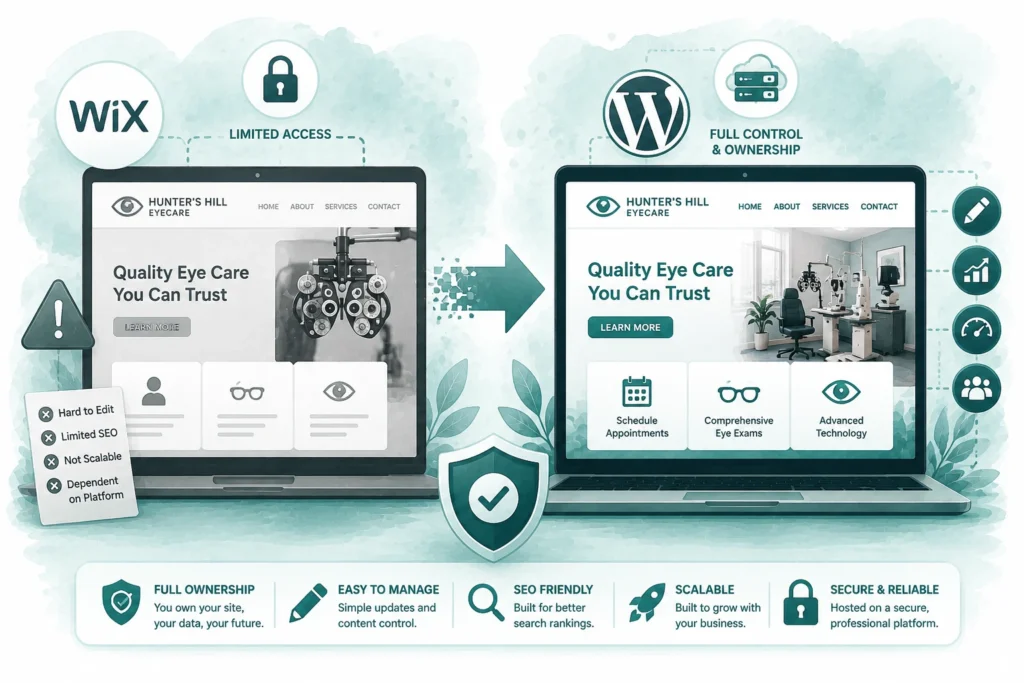
When most businesses launch a website, they’re focused on getting online quickly and affordably. That’s one reason platforms like Wix, Squarespace, and GoDaddy Website Builder have become so popular. They offer a relatively simple way to create a website without hiring a developer.
For many businesses, that’s exactly what they need at the beginning.
But as a business grows, the website often becomes more than an online brochure. It becomes a marketing tool, a communication platform, a source of leads, and in many cases, a critical part of daily operations. When that happens, limitations that once seemed minor can suddenly become major obstacles.
Recently, MAjor Designs worked with a new client, Hunter’s Hill Eyecare, on a project that perfectly illustrates this challenge.
The Original Website Worked… Until It Didn’t
Hunter’s Hill Eyecare previously operated their website through Wix. At first glance, there wasn’t necessarily anything wrong with that decision. Wix provided a straightforward way to establish an online presence and publish information about the practice.
The real problem wasn’t the platform itself. The problem was ownership and access. Over time, the login credentials for the website were lost. The individual who originally managed the website was no longer involved, and the information needed to access the Wix account was unavailable. Without access to the account, the practice was effectively locked out of its own website.
- Simple content updates became impossible.
- Changes couldn’t be made.
- New features couldn’t be added.
The business had a website, but it no longer had control over it. That’s a situation I encounter more often than most people realize.
The Hidden Risk Many Businesses Never Consider
Most business owners think about their website in terms of design.
- Will it look professional?
- Will it work on mobile devices?
- Will it help generate leads?
Those are important questions. But one of the most important questions often gets overlooked:
Who actually owns and controls the website?
I’ve seen situations where:
- Former employees controlled website accounts.
- Agencies disappeared.
- Freelancers became unreachable.
- Domain registrations were tied to personal email addresses.
- Hosting accounts were inaccessible.
- Website builders locked businesses into proprietary platforms.
Everything works fine until someone needs access. Then suddenly a business discovers they don’t actually control one of their most important digital assets.
Why Rebuilding Made More Sense Than Fighting the Platform
In the case of Hunter’s Hill Eyecare, we evaluated the available options.
Recovering access to the existing Wix website would have involved uncertainty, delays, and continued dependence on a platform that already wasn’t meeting the long-term needs of the practice. Instead, we made the decision to build a completely new website using WordPress. This provided several advantages:
Full Ownership
- The client now controls their hosting, website files, content, and administrative access.
- No dependency on a former employee.
- No dependency on a third-party account that nobody can access.
- No uncertainty about who controls what.
Better Flexibility
As practices grow, websites often need to grow with them.
- Appointment requests.
- Patient resources.
- Custom forms.
- Search engine optimization.
- Location-specific content.
WordPress allows these features to be added without rebuilding the entire website from scratch.
Easier Long-Term Maintenance
A website should be easy to maintain years after launch. The new Hunter’s Hill Eyecare website was built with future updates in mind so content changes, new pages, and enhancements can be made efficiently as the practice evolves.
Building More Than a Replacement
The goal wasn’t simply to recreate the old website. If we were going through the effort of rebuilding, the result needed to be an improvement.
That meant:
- A modern responsive design.
- Improved performance.
- Better content organization.
- Easier navigation.
- Search engine friendly page structure.
- Improved mobile usability.
- A platform that could support future growth.
In many website rescue projects, this becomes the silver lining. Businesses often start the process because of a problem, but end up with a website that’s significantly stronger than what they had before.
A Website Should Be an Asset, Not a Dependency
One of the biggest lessons from this project is that convenience and ownership are not always the same thing. Website builders can be excellent tools for getting started.
But as a business grows, it’s worth asking:
- Do we control our domain?
- Do we control our hosting?
- Do we have access to our website files?
- Do we know where our credentials are stored?
- Could we move our website if we needed to?
If the answer to those questions is unclear, there may be risk hiding beneath the surface. A website isn’t just another software subscription. For many businesses, it’s one of the most important assets they own. Treating it that way can prevent major headaches down the road.
Final Thoughts
The Hunter’s Hill Eyecare project wasn’t just about replacing a website. It was about restoring control. By moving from a locked-down situation to a fully managed WordPress platform, the practice now has the flexibility, ownership, and long-term stability needed to support future growth.
And while every situation is different, the lesson applies to businesses of every size:
- Make sure you don’t just have a website.
- Make sure you actually control it.